
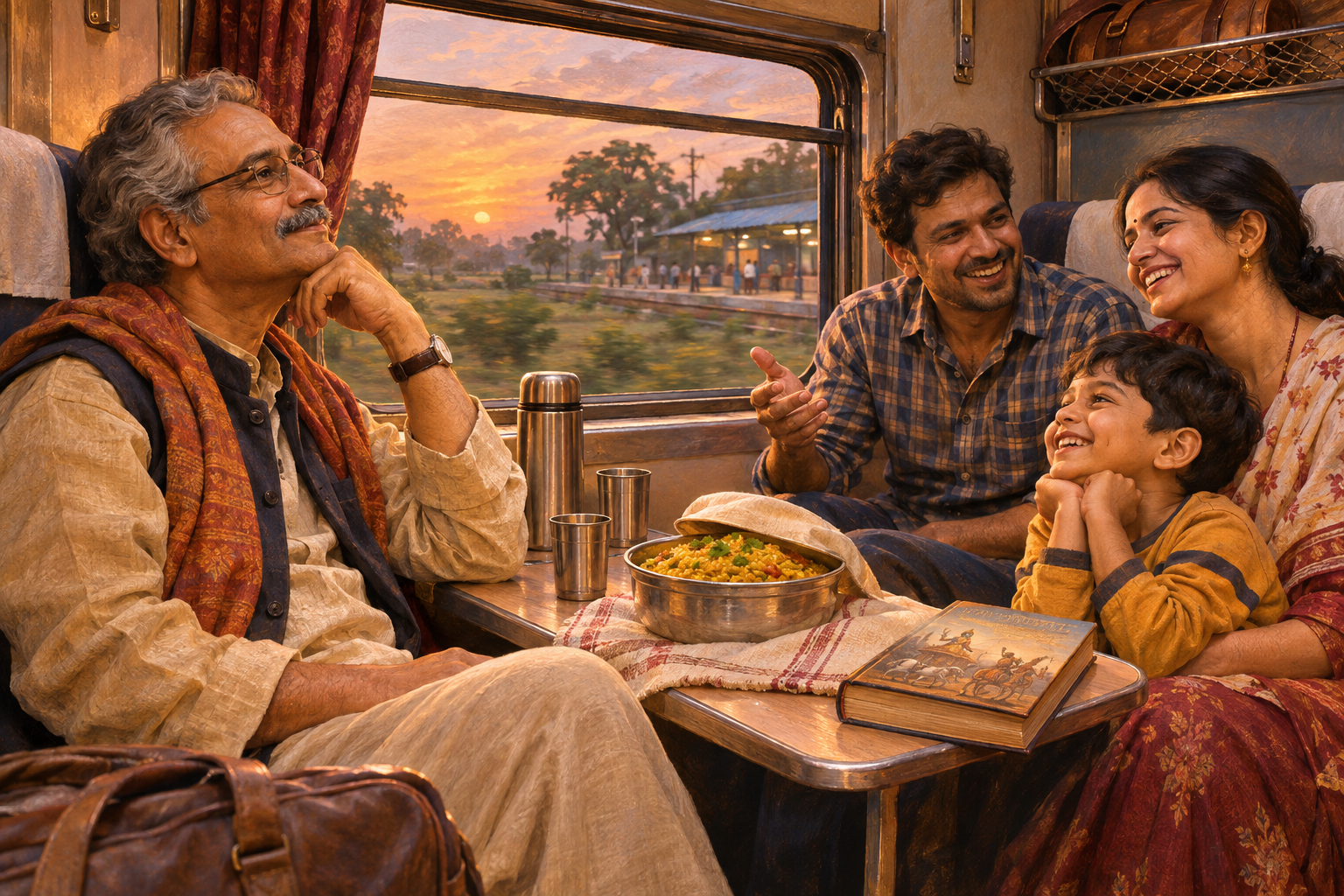
It had been nearly twenty years since I last travelled by train in India.
After moving to Singapore, my visits to India had generally been brief, seldom extending beyond two or three weeks. Air travel had become the natural choice, and the romance, unpredictability and occasional absurdities of Indian Railways had gradually faded into distant memory.
The last railway journey I could distinctly recall was from Kolkata to Motihari in 2005.
And now, two decades later, circumstances had conspired to put me back on an Indian train, this time from Ranchi to Bilaspur.
Little did I realise that this seemingly ordinary journey would turn into an unforgettable adventure, featuring an enterprising young woman, a handsome engineer, his charming family, a perpetually sleepy railway attendant, some remarkable coincidences, profound spiritual conversations and, above all, a rather elusive plate of masala daal khichdi!
The Journey Begins
Even booking the railway ticket was something of an adventure.
Having been away from the Indian railway system for so long, I was hardly familiar with the intricacies of IRCTC reservations. Fortunately, with some assistance from my relatives, the ticket was arranged.
I was to travel First Class AC from Hatia, near Ranchi, to Bilaspur.
I looked forward to rediscovering the experience of Indian railway travel, particularly the comfort and relative privacy of a First Class AC compartment.
After all, twenty years is a long time. Surely, much must have changed!
Or so I thought.
The Young Woman at Hatia Station
After tipping my Uber driver, I stepped out at Hatia Railway Station with a moderate amount of luggage.
I could easily have carried it myself. Nevertheless, I began looking for a coolie, not so much to carry my bags as to help me navigate the station, locate the correct platform and identify my coach.
Eventually, I spotted a petite young woman wearing the familiar red uniform of a railway porter.
I approached her somewhat hesitantly.
To my pleasant surprise, she readily agreed to help.
She took charge of my luggage and escorted me towards the train.
But locating my berth proved unexpectedly complicated.
My ticket did not mention the berth number!
While I was wondering how to resolve this mystery, a young man who had entered the compartment came to my rescue. Using my PNR number, he quickly retrieved the missing information.
Problem solved!
I settled into my allotted berth and tipped the young porter generously.
During our brief conversation, I sensed that she lacked confidence and perhaps suffered from a feeling of inferiority about her occupation.
I offered her a few words of encouragement, reminding her that there was dignity in every form of honest work and that she had every reason to take pride in earning her livelihood through her own efforts.
She departed, and I was left reflecting on how even the briefest encounters can offer opportunities for human connection.
Soon, a gentleman entered the compartment.
I assumed he would be my travelling companion.
But he subsequently decided to move to another coupe, leaving me alone for a few minutes.
I had no idea that the real hero of my story was about to make his grand entrance.
Enter the Hero of My Story!
And then he appeared!
A handsome, bearded young man entered the compartment, accompanied by his wife and a small child whose head had recently been tonsured.
The little fellow was a bundle of energy, remarkably agile and constantly on the move.
Our hero's parents had also come to see the family off. They remained inside the coach for about fifteen minutes, exchanging the familiar instructions, reminders and affectionate warnings that invariably accompany an Indian family farewell.
I could almost anticipate what would be said next!
Meanwhile, I had chosen to remain rather smug and reticent, content to observe the proceedings and occasionally glance out of the window.
At precisely 4:20 p.m., the train began moving.
I experienced a sudden déjà vu of Achche Din!
"Oh, wow!" I exclaimed inwardly. "Indian Railways seems to have finally reached Singapore standards of punctuality!"
Singapore, after all, had been my home for many years, and punctuality was something I had come to take almost for granted.
But my excitement was somewhat premature.
The broken toilet latches, the almost dysfunctional attendant and the conspicuous absence of a passenger reservation chart told a rather different story.
Clearly, punctuality had arrived ahead of progress!
Breaking the Ice
For a while, I continued observing my fellow passengers.
Eventually, curiosity got the better of me.
"Are you travelling to Mumbai?" I asked.
It was hardly the most imaginative conversation starter, but it served its purpose admirably.
The ice was broken!
I soon discovered that the young couple were just as inquisitive about me as I was about them.
Within minutes, an extraordinary series of coincidences began unfolding.
We realised that we had attended the same college and shared connections with HEC Colony in Ranchi.
And then came another revelation.
My newfound companion worked with ONGC!
That meant we belonged to the same oil and gas industry!
He was an engineer associated with oil-rig operations at Ankleshwar.
Suddenly, what had begun as a casual exchange between strangers became an animated conversation between people who shared not merely professional interests but also familiar places, institutions and experiences.
One coincidence led to another.
The conversation became increasingly lively, and the distance between us, both figuratively and emotionally, began disappearing.
A Blessing in Disguise?
The overindulgence in thekuas and the generally rich and sumptuous food during my stay in Ranchi had begun taking a toll on my digestive system.
I was therefore secretly relieved to find no signs of food being served on the train.
Perhaps this was a blessing in disguise!
Of late, I had been practising occasional fasting to give my overworked stomach some respite. I had also developed considerable interest in autophagy, the body's natural process of cellular cleansing and recycling.
I vaguely remembered, however, that First Class AC travel on Indian Railways once included provisions for meals.
Was that still the case?
There was no obvious indication.
Nor did the railway attendant seem particularly inclined to provide any useful information.
At that point, I was perfectly content to travel without dinner.
But destiny, it seemed, had other plans.
And those plans involved masala daal khichdi!
The Zomato Miracle
In the midst of our increasingly engaging conversation, the young engineer suddenly asked:
"Would you like us to order some food for you? We are ordering ours through Zomato."
I had heard about this facility, but here was a live demonstration!
The couple explained that they could select a restaurant in Rourkela, place an order online and have the food delivered directly to the train when it reached the station approximately two hours later.
I found the entire arrangement fascinating.
Imagine ordering freshly prepared restaurant food while travelling on an Indian train!
This was certainly something I had never experienced during my railway journeys two decades earlier.
The young man was genuinely keen that I should eat something.
Initially, I hesitated.
After all, I had almost convinced myself that a little fasting would do my digestive system a world of good.
But his warmth and insistence were difficult to resist.
We discussed the available options, including sabudana khichdi and masala daal khichdi.
Finally, I settled for a small portion of masala daal khichdi.
A modest meal, I thought, would be just right.
Little did I know that this innocent decision would eventually provide the title, the central mystery and much of the comedy of my entire travelogue!
From Khichdi to the Bhagavad Gita
With the dinner arrangements taken care of, our conversation moved into deeper territory.
Somehow, we began discussing spirituality, devotion and the Bhagavad Gita.
I have increasingly come to regard the Gita not merely as a sacred scripture but as a practical guide to navigating the countless challenges, contradictions and uncertainties of everyday life.
I spoke about the importance of surrendering oneself to God.
I minced no words in expressing my conviction that when someone genuinely surrenders to the Divine, their deepest aspirations find fulfilment in ways that often transcend ordinary expectations.
I shared examples from my own life, explaining how several dreams that had once appeared distant or improbable had, through what I perceived as divine grace, miraculously come true over the course of my six decades.
The discussion then turned to food habits.
Our hero was a committed meat eater, whereas his wife was a pure vegetarian.
This provided another opportunity for me to share a personal experience.
I explained how, about thirty years earlier, I had given up non-vegetarian food altogether.
It had been no small transformation.
There was a time when I had an enormous craving for meat and other non-vegetarian delicacies. Yet, gradually, that craving disappeared, and I became a complete vegetarian.
For me, this change was another example of how deeply ingrained habits and preferences can be transformed.
Our conversation continued, moving effortlessly between professional experiences, personal anecdotes, spiritual questions and the mysteries of life.
What had begun as an ordinary railway journey was becoming an extraordinarily enriching experience.
Time to Retire
Eventually, sleep began calling.
I decided to retire to the upper berth, leaving the lower berth available to the young couple and their energetic little boy.
It seemed the most practical arrangement.
Before settling down, I was still aware that my masala daal khichdi was expected to arrive at Rourkela.
But I had grown sleepy, and the prospect of a little rest was becoming increasingly attractive.
The railway attendant, who had already demonstrated a remarkable talent for doing very little, was supposed to be available to assist passengers.
Surely, I thought, between the attendant and my friendly fellow travellers, the modest business of receiving a plate of khichdi could not possibly become complicated.
How wrong I was!
The Khichdi That Arrived but Was Never Eaten!
Somewhere along the journey, the train reached Rourkela, and the much-awaited food was delivered.
The Zomato arrangement had worked!
My generous young companion had kept his promise, and the masala daal khichdi had indeed arrived.
Unfortunately, I was fast asleep.
By the time I woke up, the khichdi had lost whatever warmth it once possessed.
There it was, waiting patiently for its rightful owner!
But the prospect of eating cold khichdi was hardly appealing.
To complicate matters further, there was no disposable spoon.
Water was another problem. There appeared to be no satisfactory arrangement for obtaining drinking water from the railway staff.
I was confronted with a curious dilemma.
Should I eat the cold khichdi, somehow managing without a spoon? Or should I regard the entire episode as divine encouragement to continue my occasional fasting?
My growing fascination with autophagy offered a convenient justification for the latter!
Thus, after all the excitement surrounding its selection, ordering and delivery, the celebrated masala daal khichdi remained uneaten.
The irony was delicious, even if the khichdi itself was not!
And the drama was far from over.
The Real Hero Turns Out to Be the Attendant!
Until this point, I had assumed that the handsome engineer working on an oil rig at Ankleshwar was the principal character of my story.
After all, he had provided companionship, fascinating conversations, extraordinary hospitality and, most importantly, the plate of masala daal khichdi.
But I had seriously underestimated another member of the cast.
The scrawny railway attendant!
This gentleman seemed to possess an extraordinary devotion to sleep.
His commitment to that noble activity was so complete that the ordinary responsibilities of his occupation appeared to be little more than occasional interruptions.
Not only had he proved singularly unhelpful in matters concerning food and drinking water, but he was now about to perform his greatest disappearing act.
I had asked him to wake me at approximately 4:30 a.m. so that I could prepare to alight at Bilaspur.
It was a simple request.
Or so I believed.
But our attendant apparently considered uninterrupted sleep a higher calling than the discharge of his professional duties.
He failed to wake me!
Indeed, I was beginning to suspect that this man had mastered a particularly advanced form of detachment.
Unfortunately, it was detachment from his duties rather than from the fruits of his actions, as prescribed in the Bhagavad Gita!
A Narrow Escape at Bilaspur
Fortunately, I had been mentally composing this very travelogue.
The incidents of the journey, the conversations, the coincidences and the comedy of the elusive khichdi had been occupying my thoughts.
And somehow, this preoccupation helped me wake up in time.
Had I relied entirely on the attendant, I might well have travelled beyond Bilaspur!
My nephew and his driver were waiting at the station to receive me.
But there was one final surprise.
I had to manage the business of opening the train door myself!
So much for the attentive service one might reasonably expect in First Class AC.
After a few anxious moments, I managed to get down with my luggage.
There stood my nephew, just a year younger than me, waiting to welcome me.
I embraced him warmly.
The journey had finally ended.
But the story had not.
For the most important part of this experience was still unfolding within my own mind.
The Epilogue: Beyond Achche Din and Bure Din
Was this railway journey very different from those I had undertaken some two decades earlier?
Had I experienced the much-celebrated Achche Din—the good days so vehemently promised and passionately projected?
In certain respects, I must confess, I had witnessed deterioration rather than improvement.
The broken toilet latches, the unhelpful attendant, the lack of basic conveniences and the curious absence of arrangements that I remembered from earlier journeys had all been disappointing.
There were moments when I wondered whether I should complain, criticise or simply lament the state of affairs.
But then I decided otherwise.
I turned to the timeless wisdom of the Bhagavad Gita, which has increasingly become my guiding light in navigating life's countless experiences.
Why should I spend my precious moments searching for Achche Din or fretting over Bure Din?
Why allow external circumstances, whether pleasant or unpleasant, to dictate my inner happiness?
Would it not be far wiser to relish the bliss of the present moment, recognising the invisible hand of the Divine in everything that happens and everyone who crosses my path?
After all, the Bhagavad Gita teaches us to remain equanimous amidst life's inevitable dualities of pleasure and pain, success and failure, comfort and discomfort.
सुखदुःखे समे कृत्वा लाभालाभौ जयाजयौ।
Treat pleasure and pain, gain and loss, victory and defeat with equanimity.
— Bhagavad Gita 2.38
As these thoughts crossed my mind, a profound sense of peace and contentment began filling my heart.
I realised that the journey had actually been extraordinarily rewarding.
Had I not met a hardworking young woman at Hatia Station who reminded me of the dignity of honest labour?
Had I not encountered a delightful young family whose warmth and generosity had transformed an otherwise routine journey into a memorable human experience?
Had I not discovered unexpected connections with my college, HEC Colony and the oil and gas industry?
Had I not enjoyed an engaging spiritual conversation about surrender, devotion and the remarkable transformations that life can bring?
And had I not encountered a railway attendant whose extraordinary attachment to sleep had provided me with an amusing lesson in the art of accepting life's imperfections?
Even the uneaten masala daal khichdi had served a purpose!
It had become a symbol of something much larger.
Life does not always give us what we expect, when we expect it, or in the form in which we expect it. Yet every experience can become a source of joy, learning and gratitude if we cultivate the right attitude.
Perhaps the true meaning of Achche Din lies not in the perfection of external circumstances but in the serenity of our own minds.
And perhaps Bure Din are not necessarily days when things go wrong, but days when we forget to recognise the Divine presence amidst life's apparent imperfections.
As I embraced my nephew at Bilaspur, I resolved to apply this very philosophy to the day that was just unfolding before me.
Who knew how many interesting episodes, unexpected encounters and delightful surprises that day might be concealing in its belly?
I would welcome them all.
Not with anxiety or excessive expectations, but with gratitude, curiosity and faith.
And what about the masala daal khichdi?
Well, needless to say, someday, somewhere, I shall certainly sit down to enjoy a freshly prepared, piping-hot plate of masala daal khichdi.
And as I savour every spoonful, I shall fondly reminisce about that unforgettable railway journey from Ranchi to Bilaspur.
I shall remember the young porter, the handsome engineer, his charming wife and energetic child, the extraordinary coincidences, the spiritual conversations and, of course, the railway attendant whose love of sleep was almost worthy of a place in the Guinness Book of World Records!
Above all, I shall remember the beautiful lesson that this journey reinforced:
Achche Din and Bure Din will come and go. But the bliss of the present moment, the warmth of human relationships and the grace of the Divine are always available to those who know how to recognise them.
And perhaps that is the real secret of happiness.
Not to wait for Achche Din.
Not to fear Bure Din.
But to discover the Divine in every day.
राधे राधे! 🙏